Brisbane was a week.
That is the whole of what I can give you about Brisbane — a week, and then it was over. Not because nothing happened there, but because what happened there was the absence of everything. No light, no traction, no moment when the building and its people and its programme reached anything inside me that could receive it. Buderim had given something real. I had felt the wind on my face on a beach and said the word good and meant it, briefly, and that had been real. Brisbane took nothing from me because by the time I arrived there was nothing left to take.
The hospital was not Nambour. Brisbane was better. Clean. Adequate. But it was not Buderim, and arriving there from Buderim was its own loss — the crackers at two in the morning, the garden, Ron, the faces I had learned. Gone. A shared room now, with whoever happened to be on the other side of the curtain, which changed twice in the space of seven days. You learn a person's breathing before you learn anything else about them. Then they go and someone new arrives and you learn their breathing instead.
I said nothing about the shared room because there was nothing to be done. Private space had become, over the months at Buderim, one of the few things that had any value. Here there was a curtain and the sound of someone else's sleep and the knowledge that whatever happened in the night there would be a witness to it. So I walked the corridors instead. The building had windows along the outer walls and I walked toward them and stood at them and looked out at what was on the other side. Roads. Cars moving. People going about the ordinary world that had stopped including me. I pressed nothing against the glass. I just looked, and then I walked to the next window and looked from there.
The classes I did not attend. The energy required to sit in a room and process whatever was being offered had been spent on things I couldn't account for, leaving nothing. So I walked and I stood at windows and I went back to the room and lay on the bed and stared at the ceiling and waited for the week to end, which it did — quietly, without ceremony, Paula arriving at a door one afternoon to take me home.
The guilt about Deb moved through everything. Not a clean guilt — not the straightforward guilt of having done something wrong and knowing what the wrong thing was. A guilt complicated by not knowing what had happened to her, by the silence from her phone and what her boyfriend had made sure Paula understood the reason for. I had sent those messages into that silence not knowing what it held. The bruises Paula described, the phone in his hand, him walking into the cafe — these had arrived in me like something physical and had not left. I lay in the shared room and thought about her and the thinking produced nothing useful and I kept doing it anyway. She had been somewhere very dark. I had seen how dark. And now I didn't know where she was.
On the fifth day, a message came through.
She was alright. Things had settled enough in the household that she felt safe enough to make contact — carefully, briefly, watching what she said. The relief that arrived when I read it was physical. A loosening of something that had been held rigid since Buderim. She was somewhere. She was reachable. I sent one message back, two at the most. That was all that was safe. He was still watching very closely and she was still navigating whatever she was navigating, and so that was the level of contact we kept — one or two messages each day, no more, the minimum that could be managed without drawing attention. It was not nothing. In those days, it was close to everything.
Paula and I spoke a little. Not much. We were still in contact the way two people are in contact when there is still a practical requirement — the arrangement of discharge, the drive home, the logistics of a life that had not yet fully dismantled itself. Beyond that, nothing.
She drove me home. I went to the spare room.
The spare room had stopped being a room.
I am not sure when exactly it happened — the transition from a space I occupied to a space that had become a direct expression of whatever was happening inside me. Nothing was put away. Nothing was in any particular place. Clothes where they had been dropped, things moved and not returned, the accumulating disorder of a person who had stopped registering the world around him well enough to maintain any relationship with it. It looked the way I felt, which is to say it looked like nothing you would want to spend time in and nothing you could easily leave.
Most nights I slept in the bed. I say slept — I lay in it, which is a different thing. The sheets soaked through again, the nightmares returning me to the surface for the third or fourth time since midnight, the familiar arithmetic of a night that had given nothing and taken everything. But there were other nights. Nights when the accounting inside my head reached a verdict of a particular severity, when I had been especially brutal with myself and the bed felt like a comfort I had no right to. Those nights I moved to the floor — quietly, without ceremony, the cold of the timber more honest than any surface designed for rest. I would be back in the bed before morning. I always moved back before morning, when the exhaustion finally outweighed the verdict.
Every morning I stripped the sheets and washed them and put them back. This was the shape of the days — the washing of sheets, the moving through rooms that had nothing in them for me, the coffee I made and drank without tasting. I did not go to the cafe. I understood what it had cost Paula for me to do what I had done with Deb, and I understood that the cafe was her space — the thing she had built with her own hands in the middle of her own darkness — and that arriving there now would be a particular kind of cruelty on top of all the others. So I stayed in the house. I stayed in the house and I waited for the days to end and then I washed the sheets and waited for the next one.
The things that had worked before — even briefly, even at a fraction of what they once were — had stopped working. The walking track with Safi. The lemon myrtle call, Paula's voice on the phone describing ordinary cafe life while I lay in the spare room with my eyes closed. The scratches that had once interrupted the signal for long enough to take a breath. None of it reached anything anymore. The returns had been diminishing for a long time and now the account was empty. I would do the things that had once provided even thirty seconds of relief and feel nothing from them. And the nothing was worse than the pain, because the pain at least confirmed there was still someone inside to feel it.
There was no structure to the days. There was nothing to move toward, nothing to hope for, no version of tomorrow that looked different from today. I understood this not as a feeling but as a fact — the way you understand a fact when you have been inside it long enough that it has stopped requiring argument. The joy was gone from everything it had ever lived in. The humour was gone. The wit that had always been there, the thing that had made rooms lighter, was so completely absent that I could not have told you where it used to come from. Boo-Boo was a person I had heard stories about.
The thought of ending things had not left.
It had been there before with the full weight of its logic — the forest road, the sealed car, the peace of the voice going quiet. That version had carried the illusion that by ending things I would be doing the people around me a favour. That the weight I had become would simply be lifted and they would breathe more easily. The logic was clean and the voice had always been good at clean logic. There were faces that disturbed it, sometimes — the neighbour, Paula, the compliance officer — but they troubled the logic without breaking it.
The illusion held. And with it, its conclusion: that the only exit still open was also the one that made sense.
What remained alongside it was this: an existence without warmth, without structure, without any of the things that had once made it possible to say the word good and mean it. Not a life exactly. More the outline of one — the shape of a man going through the motions of days.
I couldn't understand why Paula was still there. I couldn't understand how the neighbours across the road still smiled and waved. What I had become was visible, or should have been — the sheets every morning, the spare room, the evidence accumulating the way evidence does when a person has stopped caring whether it accumulates. And still they were there. Still the wave from across the road. Still Paula in the house. The part of me that had once been good at reading people had no explanation for this, and so I filed it with the voice, which had plenty to say.
Deb had been messaging for weeks by then. She was alone, she said. Depressed. She missed me. The messages arrived at intervals through the day — not demanding, not desperate in any obvious way, but carrying a weight that accumulated. She wanted to see me. She needed to see me. I read them in the spare room with the curtains half drawn and felt the pull of them and felt the guilt of the pull, one layered on the other.
She was in Brisbane. The same hospital. I found that out through the messages — the same building I had just left, the same corridors and outer windows and shared rooms. The coincidence of it felt like something, though I could not have said what.
I drove down one morning without telling Paula where I was going. The idea had formed in the way ideas form when you have been inside your own head for too long with no one else to check them against — as a solution, as a thing that made sense, as the right and straightforward thing to do. She was alone and she wanted to see me and I would go and see her and that would be that. I drove down the highway with the window open and the air moving through the car and tried to remember the last time I had done something that felt like a decision.
I parked in the hospital car park, near the trees at the far edge. As I got out of the car I could hear voices somewhere nearby, but I paid no attention. I walked into the hospital and asked at the desk about Deb.
She had left about five minutes ago, they said. Out on leave.
I turned back toward the entrance. Through the glass doors I could see the car park, the road, the shops across it. And as I walked toward the doors I saw them — already outside, already moving. Deb and her boyfriend, hand in hand, walking away from where my car was parked. They passed directly in front of the doors without looking in. She was close enough that I could see her face in profile. She was laughing at something he had said. The laugh I knew — the one that started in her eyes before it reached her mouth. They kept walking, toward the shops across the road, unhurried, a couple on an ordinary morning.
They didn’t see me. I stood at the glass and watched them until they were gone.
I walked back to the car.
Both doors had been kicked in. Driver’s side and passenger’s side, the metal dented in sharp, deliberate impressions the shape of a boot heel. I understood immediately what had happened. He had known I was coming — or had seen the car, or had been watching — and while I was inside asking at the desk, he had been out here.
I stood and looked at the doors. Then I brought both fists down hard on the bonnet, near the main frame where the metal was solid — not in anger at the car, but because I needed somewhere to put it and I was careful enough, even then, to choose a place that would bruise my hands without doing more damage than that. I looked up at the sky — the hard bright Queensland blue of it, cloudless, indifferent — and I said it out loud to no one in particular.
Is there anything else?
I got in the car and drove.
My phone rang as I was leaving the car park. Deb. I looked at the screen and I let it ring out. I had one thought, clear and simple: enough. Just enough. I put the phone face down on the seat and drove home without answering.
A week later I sat on the back steps one afternoon.
I want to try to describe what had brought me there, because it was not a decision in any ordinary sense. The build-up had been coming on since morning — the familiar pressure, the signal rising past the point where the scratches and the small measures of physical pain could touch it. Those had stopped working entirely by then. The account had been empty for weeks. I went through them anyway, the way you go through a motion when the motion is the only thing left, knowing before I started that they would produce nothing. They produced nothing.
I had a disposable razor. I pressed the plastic against the edge of the bench until it cracked and pulled from inside it the thin strip of steel. I sat down on the steps. I thought: a paper cut. That was the whole of the ambition — something small, sharp, brief. Paper cuts are deceptive that way. They arrive with a sting that lasts far longer than their size suggests and I had thought, in whatever passed for thinking by then, that something that small would go unnoticed. That it would be mine. That for once I could take the edge off without anyone having to know about it.
I ran it lightly across the top of my right foot.
More blood than I had expected. Significantly more. My heart sank in the specific way that has nothing to do with fear and everything to do with the faces — the faces I was going to have to look at, the questions I was going to have to answer, the looks in the eyes of people who had already seen too much of this and were going to see it again because I could not manage a paper cut.
I pressed the hem of my shirt against the foot and held it there and thought about what came next.
I sent Paula the red myrtle text.
I sat on the steps and stared at what I had done. There was no relief in it. There was no curiosity, no strange detachment, none of the things that had been there before. There was only a different kind of pain — real, located, with edges I could feel — in place of the pain that had no edges and no source and no end. That was all it had ever been by this point. A different kind. And even that was now producing more consequence than I had the capacity to manage alone. The voice had no interest in the gap between what I had intended and what had happened. It closed that gap immediately and moved straight to verdict. I sat with it for those few minutes — the shame, the foot, the voice — and I waited.
I heard the bottom door get pushed open and the neighbour's voice calling out from under the house — Brian! Brian, where are you, mate? — and he came through the door at the bottom of the stairs and looked around and then saw me further up, my hand pressed against my foot, the blood finding its way down the step below.
He flinched. It was brief and he recovered quickly, but it was there — the involuntary recoil of a man confronted with something outside the boundaries of anything he had seen before. He was not a man who had seen this kind of thing. He had spent his life around working men who didn't do this, and what was on those steps was beyond anything his experience had given him a way to receive. And then something shifted in his eyes. I watched it happen. I couldn't tell you exactly what it was — not quite pity, not quite sorrow, something that hadn't finished becoming either of those things yet. Whatever it was, he made no attempt to hide it.
He said: just stay there, mate. We're going to get you some help. Everything's going to be alright.
The voice said: how can he say that. Doesn't he know what you are?
His wife came through the bottom door behind him. She looked up at me on the steps and then left without a word. She was a woman I can only describe as a tough old bird — that was how she came across to most people, hard as nails, not given to softness. Paula and I had always known otherwise. She had a heart of gold under all of it, a heart that had been slowly shaped by a hard life into something that looked like toughness from the outside and was something else entirely from the inside.
She came back with a maxi sanitary pad.
She passed it up to me, and something happened that I hadn't expected and could not have prepared for. I smiled. A brief, involuntary, completely genuine smile — the first in longer than I could tell you — because I was sitting on the back steps of my house with my foot bleeding and my elderly neighbour's wife had just handed me a sanitary pad and there was nothing in the world I could do about it. My sense of humour had been gone for so long that when this small remnant of it surfaced I barely recognised it. It was there for a second and then it was gone, but it had been there.
She saw it. Her shoulders came up and she said: it's all I had. It's all I thought would work.
I pressed it against the wound myself and held it there. He went to the bottom of the steps and got on the phone. While he waited he talked to me, the way he always talked — steady, unhurried. After a while he looked up at me and said:
Brian. You need to find a way to stop this, mate.
He said it the way you say something when you are not making an argument and not issuing an instruction. When you are just saying what is true because you are a person who says true things to people he cares about.
I looked at them both. Tears fell — tears of shame, not grief, the specific shame of a man who has exposed two decent elderly people to what he has become. I said: I'm sorry. I'm sorry that you are seeing this.
He said: you're going to get through this. You're going to find a way.
Then I heard it. A sound from the street — a loud bang, then the shriek of brakes and loose stones flying against the front of the house in a spray. I didn't see what happened. I heard it. I heard her car come around the corner too fast, heard the bang as it cleared the drainage ditch at an angle it was not designed for, heard the skid and the gravel scattering against the front wall before everything went quiet.
A few moments later she came through the gate. She stopped when she saw me upright. Three deliberate breaths.
She said: what have you done.
Nobody answered her. There was nothing to answer with. She came to the bottom of the steps and stood with the neighbours and the three of them were there together — people who had known each other for years across a quiet road, who had waved and exchanged small talk and borrowed things from one another — and now they were standing in my backyard waiting for an ambulance because of me, and none of them had any idea what to do with their hands or their faces or the space between them.
The tears had stopped. I noticed that without quite deciding it had happened. In their place was something harder and less presentable — a low, flat anger that had no specific target and so settled over everything equally. At the foot, at the razor, at the particular cruelty of having wanted something small and private and having produced this instead. Four people in a yard on an ordinary afternoon. The neighbours had heard the ambulance before, had seen it in the street outside, had understood at a distance what it meant. They had never seen me. This was different from knowing. I could see that in the way they stood — slightly apart from each other, not quite looking at anyone, the silence between them the silence of people who have arrived somewhere they didn't expect and haven't yet worked out what the rules are.
Paula had Safi. She had come to her without being called, the way she always came when something in the air required it, and Paula held her quietly at the bottom of the steps. That was something to do. That was a place to put the hands and the eyes while the rest of it sat unresolved in the afternoon.
I sat on the steps above all of it and I felt the anger and I felt the shame underneath the anger and I did not say anything, because there was nothing to say that would have made any of this smaller.
The ambulance came.
The crew knew me from the service. I saw the recognition cross the first officer's face and watched him absorb it in the time it took him to cross the yard — the professional mask going up, the warm words coming, the words you say to someone in crisis.
They took me through a back entrance at the hospital. Away from other crews, away from other patients, into a private room off a corridor that saw no traffic. The small mercy of people who understood what it meant to be brought into a building you had spent ten years on the other side of.
They dressed the foot and someone from psych came and asked the questions. I said I was not suicidal, which was technically true. They released me with antibiotics.
Before the officer left he said: mate, you'll be alright. When we come back in with the next patient we'll pop in and say hello.
I understood what those words were. Not a promise — a kindness said in an awkward moment, the thing you say to someone you know when you don't know what else to say. People who had been in the service long enough didn't come back. Not out of cruelty. Out of recognition. When one of their own fell over they would put on the professional mask and speak the warm words and then they wouldn't return, because returning meant looking at something that was closer than they wanted it to be. You became a reminder of the distance between where they were and where they could be. I had heard this from people in the service over the years — people who had confided things, who had always seemed to find me when they needed to say something they couldn't say elsewhere. I had understood it then in the abstract. I understood it now entirely.
Paula drove me home. I went to the spare room and lay down and faced the wall.
I knew she would be on the phone. I knew the calls would happen, the careful quiet conversations with the people who needed to be told. I didn't hear them. I lay in the spare room with the anger and the shame — not crying, not the tears that had been there before, those were gone now — just the flat, hard weight of another day that had ended like this. Another set of faces. Another set of looks. The neighbour's eyes. His wife's shoulders. Paula's three deliberate breaths before she said what have you done.
And then, through the wall, her voice. Low but audible — the sound of someone who has been holding something for a very long time and is finally putting it down in front of another person. I couldn't make out all of it. Enough. You need to do something. You can't just leave him like this. You need to do something.
She was fighting for me. On the other side of a wall I didn't know how to cross, she was fighting for me.
The voice heard her doing it.
End this. You need to finish this. Stop making her suffer.
The voice didn't need to work very hard that night. The evidence was sufficient.
Two weeks later Paula came home from the cafe later than usual.
I knew before she spoke. Not from anything specific — from the quality of the silence between her car in the driveway and the moment she came to the doorway of the spare room. Something had resolved. Something that had been approaching for a long time had arrived.
I understood that she had been speaking with the Priority One officer. I understood what that conversation would have cost her — the admission of it, the saying aloud of what she had been holding, the asking for guidance from someone whose job it was to provide it. I understood why she had done it. She had to make the logical decision, and she no longer had the capacity to make it alone, and so she had gone to someone who could help her find the shape of it.
She said: we need to separate. We need to sell the house. I can't do this anymore. Two weeks, she said. We need to have this done in two weeks.
She was not angry. There was no accusation in it, no performance. She was a woman who had reached the end of something and was saying so plainly, the way she said most things. She had already had the argument with herself and the argument was done.
I said nothing. The two weeks struck me as impossible — the sheer logistics of dismantling twenty years of a shared life in a fortnight — but I understood why she had named it. She needed something to aim at. A fixed point on the other side of this, something her mind could work toward through everything that was going to have to happen. She had set it for herself, not for me, and I knew it, and I held my tongue.
She had not done anything wrong. She had packed a bag of knives every morning for months. She had driven across a front lawn to get to me on the back steps. She had been carrying what she was carrying for years at the bottom of a pile that had everything else on top of it. She had loved me through things that would have sent a different person in the other direction long before any of this. She was not failing to love me now. She was simply past the point where love was sufficient.
The real estate agent was a woman, efficient and warm in the way of someone who had done this a great many times and understood that the transaction always sat on top of something else. She walked the house with a clipboard and a practiced eye. She came to the back deck and crouched and pressed the timber with her thumb.
Old, she said. Soft in places. You'll want to replace this before it goes to market.
Paula said she knew someone.
I did not want to replace the deck. I want to say that plainly, because the deck became one of the hardest things of that entire period in ways that nobody would have predicted and that I couldn't have explained at the time. Sell it for less, I thought. Take the reduced price. A deck is a deck. The people buying the house will fix the deck themselves and we will all be spared whatever the alternative is.
But Paula had already spoken to the neighbour before she mentioned it to me. He had offered to do it for nothing — a gesture from a man who had known us for years and who understood, in his practical and undemonstrative way, that this was a moment that called for something practical and undemonstrative. The timber was ordered. Two days later it arrived. The day after that he came through the back gate with his wheelbarrow and his tools.
He was not a young man. He had done physical work his whole life and he was good at it and he was slow at it, the way craftsmen are slow when they care about what they're making — each joint checked and rechecked, nothing rushed, the right way to do something done the right way regardless of what it cost in time. He was not good at delegating. There was rarely anything I could do except stand nearby and hold the thing he needed held, and then stand somewhere else when he needed to move, and then hold the next thing. For hours. In the Queensland summer. In a back yard that had been stripped of everything I had used to manage the days.
He talked constantly. Stories from decades back — jobs he had worked, people he had known, things that had happened before I was born. They were good stories, probably. He was a good man and he told them well. But I could not hear them. They arrived in my ears as noise — warm, well-intentioned noise that I had no mechanism to receive — and the not-hearing of them cost something. Every response I managed, every nod, every yeah, mate — each one was drawn from an account that was already empty. I was performing being present with someone who deserved actual presence, and the performance was exhausting in a way that had no name.
What I needed was to be alone — in silence, with no one watching me and no one to respond to and nothing required of me. That was the only thing that could have helped, even fractionally, and it was the one thing the deck had made impossible. But a man was doing something for me, for free, out of the goodness of him, and I was not going to be the person who walked away from that. The duty that had kept me at my desk through ten years of calls was still there, still running. So I stayed. I held the posts and I listened to the stories and I stayed.
The anger built from the first morning. At the two-week deadline, at the noise, at the heat, at the neighbour's careful overengineering of every joint when we were already behind. At myself, most of all — at the anger itself, at the fact that I was standing in my own backyard hating a decent man who was helping me. The voice ran commentary over all of it, adding its own accounting to the ledger already full of entries.
His tools were at his house across the road. He had forgotten things, or needed things he hadn't brought, and every time he said — back in two minutes — and went through the gate. Those minutes were the only ones I had. Brief windows of time when he was gone and the yard went quiet and I could breathe. I used them badly. A piece of offcut timber with a split edge. A coin from my pocket scraped hard across the inside of my wrist. Whatever was there, whatever was close, the small sharp interruption of the signal. Not enough. Never enough, but something, and something was what I had.
He would come back through the gate and I would hold the post.
By the third day I was beyond managing. The build-up that had been rising through the previous two days had nowhere left to go. When he crossed the road I went downstairs and I put my fist into the wall — not the measured scratch of a man trying to interrupt a signal, but the full force of a man who had run out of everything else. Then I came back up and held the next thing.
Safi had always come to me when I was calm — settled beside me on the evenings when the day had flattened back into its ordinary grey, her warmth against my leg, responding to what was actually there. But the house was changing. She felt all of it before the room knew it was there. By the third day of the deck she was more on edge, at Paula's side in the evenings and at a careful distance from me in the yard.
I took her for a walk each morning. She had a place five minutes down the hill — a small stream she loved, a stretch of it she would run back and forth in the water with a joy that was entirely her own, uncomplicated and complete. Sometimes she pulled ahead on the leash and I let her go and she would disappear into the undergrowth and be gone for a while, and I would sit on the bank with treats and wait. She always came back. I was never worried. I would hear her before I saw her — the crashing in the undergrowth slowing, and then she would emerge and come to my hand for the treat and I would put the leash back on and we would walk home.
The fourth day of the deck was the last day.
That morning she bolted before the leash was on. Through the back gate and down the hill and gone, the sound of her fading fast through the trees. The neighbour was at the far end of the yard and I said it's fine, she knows the way, and went upstairs for the leash and walked down the hill after her.
I walked with my fists clenching and unclenching at my sides.
There were three things happening simultaneously and they had been happening simultaneously for three days and they were all at full volume by now. The first was the voice — running its usual accounting, adding the deck to the ledger, adding the wall to the ledger, reminding me at every step of the full inventory of what I was and what I had done and what I owed. The second was underneath the voice, quieter but clearer, a statement rather than an argument: I want to die. I want this to stop. I want all of it to stop. And over both of them, worn thin but still there, still somehow operational — the duty. The same duty that had held me at my desk through the children's calls. The same duty that had kept me at the deck for three days when everything in me was screaming to leave. It was the only thing still running and it was running on nothing.
I walked down through the trees and I hated everything I could see — the trees, the light coming through them, the world going about its ordinary business around a man it had stopped including. Most of all I hated what I had become and that I could not find a way out of it that didn't destroy the people around me. The logic that had closed the exit was still intact. I understood it completely. I hated that I understood it.
The stream sounds reached me before I saw it — the shallow water over stones and underneath it Safi, already in the water, running her section back and forth.
I went into the tree line. I crouched at the edge of the water.
She ran her section twice more and then came near me on a pass and stopped. Tail slowing. Something in the way I was crouching reading differently from the usual waiting-with-treats. She came a step closer.
I became aware of my hands in the water.
I became aware of what my hands were doing.
I let go.
I pulled her up. She was shaking — the whole body shaking, legs unsteady, her eyes wide and fixed on my face. She backed away two steps and stood at the edge of the water and looked at me.
I sat in the stream. My hands in the water where they had just been. I looked at them the way you look at something that belongs to you but that you don't recognise. Foreign. Attached. Capable of a thing you could not have told anyone you were capable of.
The voice was quiet. The duty was gone. All three things that had been running simultaneously had stopped, and what replaced them was not silence but something worse — a clear, unobstructed view of what I had just done and who had done it.
I had spent years trying to help. Through every call, every shift, every broken thing I carried home — I had been, at the core of it, a person who tried. Someone who had sat with other people's worst moments and attempted to be useful to them. I had loved Paula, and my children, and the people who found me when they needed to say something they couldn't say elsewhere. That had been true. Whatever else the voice said about the accounting, that had been true.
And I had just tried to drown my Safi.
I reached down and picked up a rock from the streambed. I hit myself in the chest with it. Once, twice, three times — hard, the pain immediate and specific and located, the rage going somewhere that was at least pointed inward and at least mine. I dropped the rock. I sat there. The water moved around me. In the trees above the stream a bird made its sound and went quiet.
I wept. I sat in the water and I wept — not the tears of shame that had come on the back steps, not the managed grief of a man performing contrition in front of people he had let down. Something older and less presentable than that. I said her name. I said I'm sorry, girl. I said it more than once. The water kept moving and I kept saying it and it made no difference to what had happened and I kept saying it anyway.
After a while Safi came back.
She came to the edge of the water and stood for a moment, watching me. Then she waded in. She put her muzzle against the side of my neck, the way she had always done when she sensed something she couldn't name. I reached up and held her — both arms around her, my face against the wet of her coat — and she allowed it. Stood still and allowed it. We stayed like that in the water together for a while, the current moving around us, her heart beating against my chest where the rock had been.
I gave her the treats. I put the leash on. I walked back up the hill.
The neighbour was at the top of the yard when I came through the gate. He looked at my wet clothes and said: have a swim?
I said: something like that.
I went inside. I changed. I came back out and held the posts for the rest of the day.
I never trusted myself with her alone again. That was the decision I made on the hill walking back, quiet and final. I didn't examine it. I just made it and held it.
That night I could not sleep on my side. The chest was already bruising — a deep, spreading darkness across the sternum that would take three weeks to fade. I lay on my back and felt it and then, when the nightmares drove me close enough to the surface, I rolled deliberately onto the bruised side and pressed my weight into it. The pain arrived sharp and immediate and specific, and I held it there until I needed to breathe again. This was what the rock had been for. Not punishment, exactly — or not only that. It was something real to hold onto in a place where nothing real remained.
In the days that followed I saw Safi every morning and thought the same thought each time. I fed her more than I should have. I sat on the floor with her in the evenings and let her settle against my leg the way she always had, and I held very still, and I did not walk her.
Two days after the stream, when things had flattened back to something I could manage, I asked Paula to sit down. She had just come home from the cafe — the bag of knives at her feet, the tiredness of a long day on her, and something else underneath it that had been there for weeks and that I could not name but understood. An edge. Completely earned.
I told her what had happened at the stream.
I was crying while I told her. She said nothing throughout — just sat with the bag at her feet and listened the way she had always listened when something important was being said, without interruption, without any of the reflexive responses that make a person feel managed. When I finished I told her that was why I couldn't walk Safi anymore. That I didn't trust myself. That I needed her to take over the mornings.
She was quiet for a moment. Then she said: I understand why you did it. But it's not your fault. It's not who you are. It's the illness.
She thanked me for telling her.
I never told her about the chest.
The house was inspected twice. Both times I left with Safi and took her to the neighbours and walked around the block while strangers moved through the rooms where we had lived. Within a week a price was agreed. The moving day was set for two weeks after that.
Moving day came in stages.
Paula had found a small place at the back of a farmhouse, fifteen minutes from the cafe. Her own space, the right size, close to the thing she had built. I had not found anywhere, but the plan had been forming in conversations I had not been part of — Buderim Private again, when they had a bed, which they didn't yet because the unit was full. So the arrangement was what it was: she moved into her place, and I stayed in the house for two nights until the bed became available.
The furniture went. Each room emptied. The accumulated weight of nearly twenty years of a shared life distributed to wherever it was going — her place, storage, people who wanted things, the kerb. The house became lighter with each removal. The lightness was not the good kind.
Safi went in the morning, before the furniture moved. Friends of ours had agreed to take her in — people she knew, people whose house she had been to, whose smell was familiar to her. It was the right arrangement. It was the only arrangement. I understood this completely and it made no difference to what it felt like to watch her go.
She went through the gate with the lead in someone else's hand and didn't look back, which was the merciful version of it.
By the middle of the afternoon everything was done. The last of the furniture had gone. Paula was leaving. She found me in the house and she said it briefly — that Buderim would have a bed soon, that I needed to stay safe. Short words. The kind of words you say when the longer ones are too large to carry. There was a wall between us in that moment that neither of us had the language for, and neither of us tried. Twenty years. The whole of it ending in a few sentences in an empty house on a Tuesday afternoon on the Sunshine Coast. She left. I heard her car.
I drew the blinds.
And then I walked through the house. Room by room, standing in each doorway for a moment before moving on — the bedroom, the kitchen, the front room where the couch had been. I stood in each one and I let the rooms say what they had to say. Timber floors throughout, bare now, the pale marks where furniture had stood visible against the darker boards around them. A lighter rectangle on the wall of the bedroom where a picture had hung. Each room carrying the shape of the life that had been lived in it, rendered suddenly as negative space.
I went to the storage area under the house and brought up the sleeping bag and the camping chair and the iPad. The last things. I set them in the corner of the spare room and sat down on the cold timber floor.
The first night was long.
The empty house made sounds I hadn't heard before — or sounds I had heard and never registered because the life of the house had always been louder than they were. The pipes. The roof settling. Each room carrying its own particular silence, different from the silence of a room with furniture in it. Empty rooms have a quality of waiting to them, as if they are listening for something that has not yet arrived.
I lay in the sleeping bag on the floor and looked at the ceiling. The camping chair was in the corner. I had never sat in it. The floor was what I deserved and the floor was what I gave myself.
Sleep came eventually. The rooms came with it. The dark house, the couch, the two boys, the doorway. All of them arriving in their usual order, with their usual precision, for what felt like the entire night.
I woke in the early morning unrested. I washed my face. I made coffee in the empty kitchen and stood at the window and drank it and looked at the backyard where the deck was — new timber, pale against the old, the neighbour's careful work visible in every joint. The morning was clear and still.
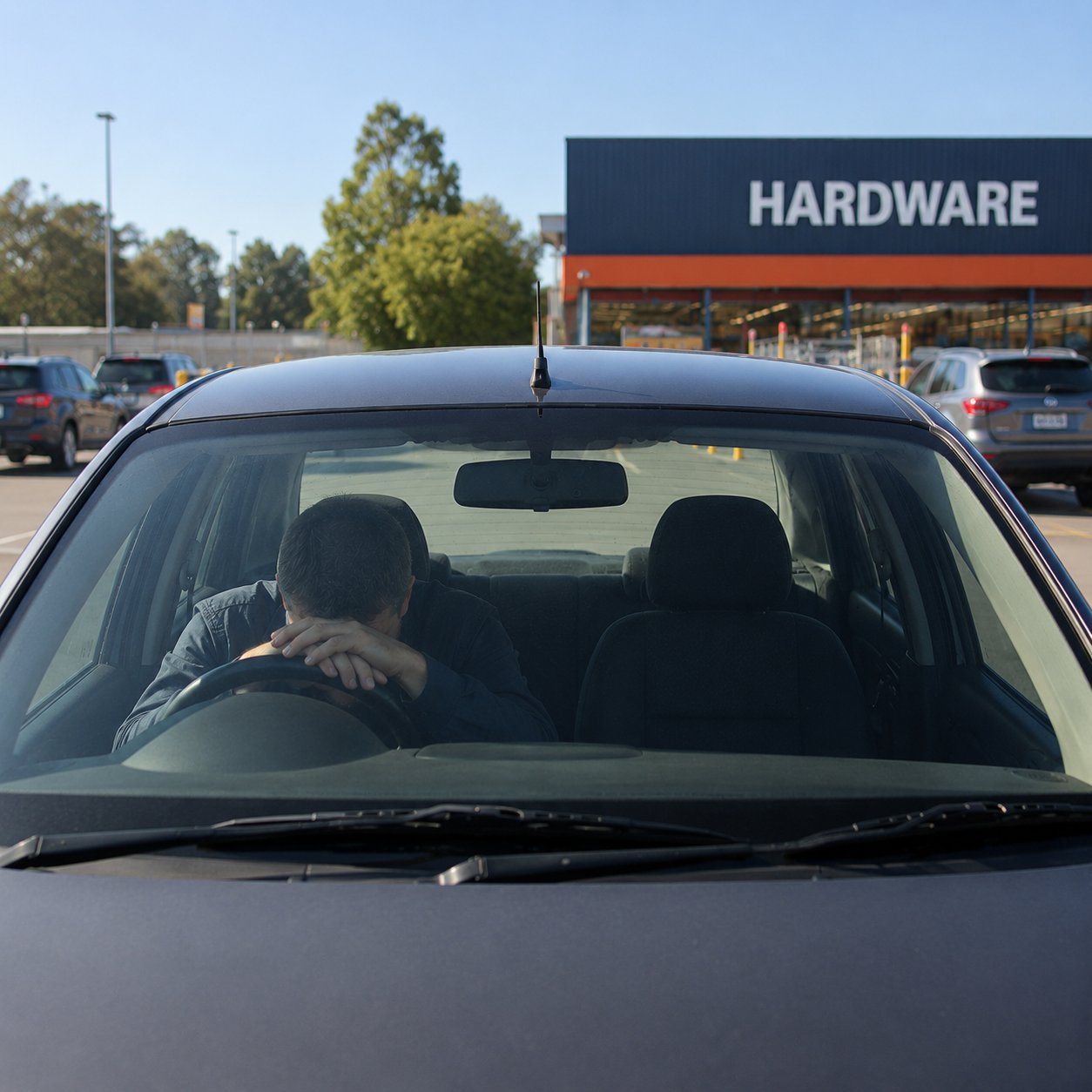
I needed to go to the hardware store. There were small things I had thought of doing to the house before the new owners moved in — minor repairs, touch-ups, the small gestures of a person who still had some residual care for the place. I got in the car.
By the time I pulled into the hardware store car park I was not thinking about the house.
I sat in the car and looked at the entrance to the store and I knew what I was going to buy when I went in, and it was not paint and it was not filler. The clarity of it was almost peaceful — the same quality the forest road had carried, years ago, that morning of pale light and birdsong and the window sealed. A decision that had found its edges. The voice was very quiet.
My phone rang.
The compliance officer. Just calling to check in, she said. Her voice had the easy warmth of someone with nothing particular to report — something that had happened at work, something funny, the ordinary texture of a day going about its business. She talked. I listened. She asked how I was going and I said fine and she kept talking, moving from one thing to the next the way she always moved, filling the space between us with the sounds of a life that was still in motion.
Twenty minutes.
When she rang off I sat in the car park for a moment and looked at the entrance to the store. And then I started the engine and I drove back.
She had not said anything that changed anything. She had not offered a reason or a reframe or any particular wisdom. She had simply been there, on the other end of the phone, talking about ordinary things, for long enough that the moment had passed. The window had closed. Not because anything had shifted inside me — nothing had shifted. But because twenty minutes had gone by and the car was still in a car park and there was nothing left to do except drive home.
I went back to the house.
The second night.
I lay in the sleeping bag on the floor where the single bed had been. The wall that Paula had been on the other side of for so long was just a wall now. The empty rooms made their sounds. The camping chair sat in the corner.
I reached for the medication.
I didn't count what I poured into my hand. I didn't look. I opened the bottle and tipped it and looked out through the window at the night sky — the particular black of it above the Sunshine Coast, the few stars that made it through the ambient light. I looked at the sky because it was there and because looking at it cost nothing, which was more than most things could offer. I swallowed what was in my hand.
I fell asleep.
I woke in the morning and lay still for a moment. The light was coming through the window. The house was still making its sounds. I was still in the sleeping bag on the floor of the empty room.
The feeling that arrived when I understood I had woken was not relief.
I lay with it. I did not reach for any interpretation of it. It was simply there — the feeling of a man who had not wanted to wake up and had woken up anyway, and who had to locate some reason to move.
After a while I got up. I folded the sleeping bag. I put it with the camping chair and the iPad in the corner that had been my corner. I went to the bathroom and looked at myself in the mirror for long enough to understand that the mirror had nothing useful to offer, and then I stopped.
I went and sat on the floor in the front room. The room where the couch had been. Not the camping chair — the floor. Back against the wall. I closed the blinds so the neighbours across the road couldn't see me.
The camping chair was right there.
I sat on the floor and I did not eat and I did not drink and the hours moved through the empty house around me.
Eventually sleep came again. And the rooms came with it — the dark house, the couch, the two boys, the doorway — arriving in their usual order, in the particular language of nightmare that does not care how many times you have already been there.
I was back in all of them before morning.
— End of Chapter Twelve —
This chapter contains descriptions of crisis. If something here has reached you, crisis support is available here · Australia: Lifeline 13 11 14 · US: 988 · UK: Samaritans 116 123 · International: findahelpline.com
The Window is a memoir in progress. It will be available here when it is finished.
← Back to BB Hope